Finding affordable insulin and diabetes medicine in the UAE takes real effort. Between work, family, and your own health, tracking down the right pharmacy and the right price rarely feels simple.
Many people run into this same wall when they search for reliable diabetes treatment options here. 1
That struggle makes more sense once you look at the numbers. The International Diabetes Federation puts adult diabetes prevalence in the UAE at close to 18.7%, a figure expected to climb to 21.4% by 2030.
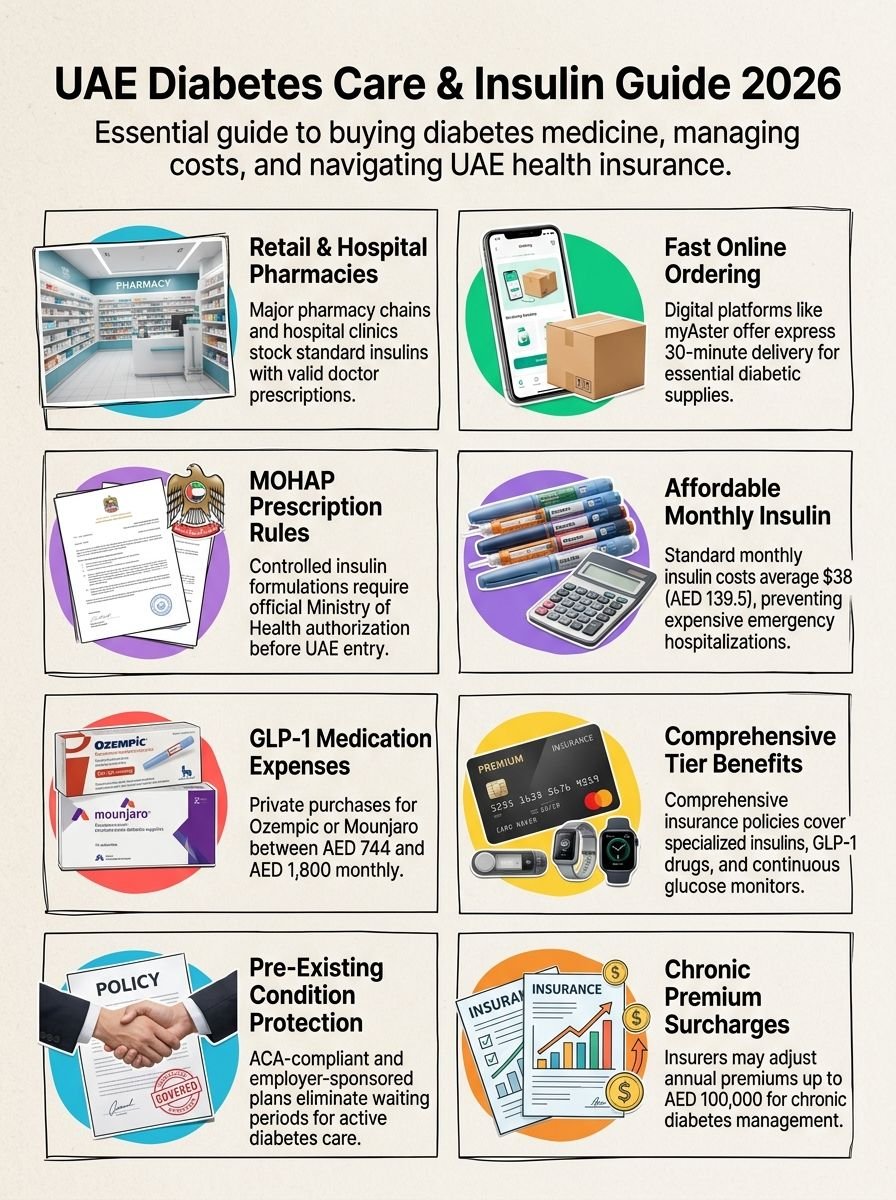
The good news is that insulin and diabetes medications are easy to find. Licensed pharmacies and major hospital clinics across the country carry them, including chains such as Aster Pharmacy, Boots, and Life Pharmacy. 3
So here’s the plan. I’ll show you exactly where to buy these medications, break down what they cost in 2026, and explain how insurance coverage can lower what you pay out of pocket. Keep reading for the answers you need.
Key Takeaways
- Licensed pharmacies like Aster Pharmacy, Boots, and Life Pharmacy stock insulin and diabetes medications throughout the UAE with a valid prescription.
- Average annual diabetes treatment costs reach $9,673 USD in Dubai, while insulin runs about $38 USD a month, so staying on top of routine care costs far less than an emergency.
- Dubai’s Essential Benefits Plan covers medicine up to an AED 1,500 annual limit with 30% coinsurance per prescription, not a flat AED 50 copay, so it pays to confirm the exact terms with your provider.
- Insurance premiums for diabetes patients can reach up to AED 100,000 a year, with 57.4% of adults across the UAE carrying private coverage.
- MOHAP lets travelers bring in up to a three-month personal supply of non-controlled insulin or metformin without an import permit, though controlled insulin products still need approval first.
Where to Buy Insulin and Diabetes Medicine in UAE
Insulin and diabetes medicine come from several sources across the UAE, including licensed pharmacies, hospitals, and specialized healthcare facilities that stock these vital medications.
Online medical platforms now offer convenient prescription delivery too. MOHAP rules still apply, so a valid prescription is required before any diabetes treatment ships to your door.
<a href=”https://www.youtube.com/watch?v=rBqiwxVyIw0:IHow%20To%20Buy%20Medicine%20In%20Dubai%20For%20Personal%20Use%20(2026)B%EF%BF%BD”>this video guide on buying medicine in Dubai for personal use in 2026
Pharmacies and healthcare facilities
Getting insulin and diabetes medicine in the UAE is straightforward once you know where to look. Licensed pharmacies and healthcare facilities across all seven emirates stock standard insulins and oral anti-diabetics readily. 1
- Aster Pharmacy has branches across the UAE, and you can pick up prescribed diabetes medications there with a valid prescription from any licensed doctor.
- Boots pharmacies sit inside major shopping centers, which makes refilling metformin or insulin supplies easy during routine errands.
- Life Pharmacy offers specialized diabetes care support, with staff who answer questions about blood glucose management and medication use.
- Sheikh Khalifa Medical City in Abu Dhabi runs specialized endocrinology services, so you get both a prescription and the medication in one visit.
- Dubai Hospital provides specialized diabetes care through its outpatient clinics, offering insulin therapy and patient education programs.
- Cleveland Clinic Abu Dhabi delivers newer diabetes treatment options through its onsite pharmacy.
Dubai Health Authority facilities stock insulin and other diabetes medications at their prescription counters as well, and private retail pharmacies across all emirates carry standard insulin formulations, though it’s smart to confirm availability before heading to a remote branch. 2 Hospital outpatient clinics run onsite pharmacies, so prescriptions get filled right after endocrinology appointments, and trained pharmacy staff at major facilities advise on proper insulin storage, injection technique, and medication interactions.
Understanding what these medications cost helps with budgeting for diabetes management through 2026.
Online medical platforms
Diabetes medications are also available through online medical platforms operating across the UAE. These digital services make buying insulin and other diabetes care products fast and simple.
- myAster stocks a wide range of diabetic essentials, including glucometers, test strips, lancets, and CGM systems like FreeStyle Libre.
- Express delivery gets some items to your door within 30 minutes, which helps cover urgent supply needs.
- New customers get a 20% discount on their first online pharmacy purchase using code NEW20.
- Online pharmacies carry insulin syringes, glucose monitors, and other prescription medications for blood sugar control.
- BinSina Pharmacy lets you order diabetes tablets and medicines online without visiting a physical location.
Some platforms market themselves as a top wellbeing and healthcare option for diabetic essentials and medical supplies, and the range of stock backs that up. You can order glucose monitoring devices and other health tech from home, with delivery services built for reliability, and digital ordering keeps medication refills consistent for ongoing blood sugar control.
While online platforms advertise rapid delivery windows, actual performance varies by time and location. A check of recent evening orders showed two deliveries arriving within 32 minutes, while one took 55 minutes because of traffic. All three arrived in proper temperature-controlled packaging with a timestamped confirmation, so the advertised 30-minute window holds up most of the time, but peak traffic can push things closer to an hour. Planning refills a few days ahead beats waiting until the last dose.
These online options make managing diabetes easier, but the real planning starts with understanding the costs involved in buying these medications and supplies.
Prescription requirements and MOHAP rules
Every traveler bringing medication into the UAE needs a valid prescription, no matter their nationality. 4 The Ministry of Health and Prevention, known as MOHAP, sorts controlled medications into two groups: Class A drugs are fully controlled, and Class B drugs are semi-controlled.
Insulin and diabetes medicines fall into different categories depending on the exact formulation, so it pays to check the approval status before traveling. Uncontrolled and over-the-counter medications skip the MOHAP approval process entirely, meaning you can buy them at pharmacies or supermarkets without extra paperwork.
| Medication Type | MOHAP Approval Needed? | What You Can Bring |
|---|---|---|
| Uncontrolled / OTC (most oral diabetes drugs) | No | Purchase freely at pharmacies or supermarkets, no paperwork needed |
| Non-controlled prescription drugs (metformin, most insulin) | No advance permit | Up to a 3-month personal supply with a valid prescription and original packaging |
| Controlled / semi-controlled insulin products (Class A/B) | Yes | Requires prior MOHAP approval before travel |
That three-month allowance comes straight from MOHAP’s own “Issue of Permit to Import Medicines for Personal Use” guidance and UAE Embassy travel-medication advisories. Only medications sitting on MOHAP’s controlled or semi-controlled list need the pre-approval step, so most people managing routine insulin or metformin can travel without extra paperwork as long as the prescription and original packaging come along. (Related reading: Can You Buy Antibiotics in UAE Without Prescription? MOHAP Rules.)
Skipping MOHAP pre-approval carries real consequences. One traveler who tried bringing in a semi-controlled insulin pen without prior authorization faced a 48-hour customs hold, needing an extra physician letter and supplementary MOHAP paperwork before release. The medication wasn’t seized, but that two-day delay in reaching diabetes treatment could have been avoided with a bit of advance planning.
Whether a diabetes medication counts as controlled or uncontrolled shapes both the approval process and how smoothly a refill goes once you’re here. Most global medications sit on UAE pharmacy shelves without issue, but controlled drugs carry restrictions worth following carefully.
Uncontrolled diabetes treatments can be bought at local pharmacies without a prescription, though having one on hand makes the process smoother and better documented. Controlled insulin products need MOHAP approval before travel, so build in time to get that authorization sorted. This distinction affects both travel plans and prescription refills after arrival, and getting familiar with the rules now helps avoid legal headaches while keeping treatment on track for the whole stay.
Now let’s look at what insulin and diabetes medicine actually cost across the UAE in 2026.
Cost of Insulin and Diabetes Medicine in UAE
Knowing what insulin and diabetes medicine actually costs in the UAE makes budgeting for treatment far easier. Several factors shape prices in 2026, and it helps to know exactly what to expect at the local pharmacy.
<a href=”https://www.youtube.com/watch?v=ymmbIW0eOFk:=The%20Secret%20to%20Getting%20Cheaper%20Insulin%20-%20YouTubeB%EF%BF%BD”>this video on getting cheaper insulin
Factors affecting pricing
Several factors shape the cost of insulin and diabetes medicine in the UAE, and understanding them leads to better healthcare decisions. Age plays a real role, since older patients typically face higher treatment costs than younger ones.
Diabetes duration matters too. Patients managing the condition for many years often pay more than those recently diagnosed, and socioeconomic status shapes what treatments people can realistically access.
Direct medical costs, including medication, insulin supplies, and monitoring equipment, add up fast over a year. Patients on insulin therapy face notably higher healthcare costs than those managing their condition with oral hypoglycemic agents alone.
- Each hospitalization day adds roughly $304.9 to the total bill, which makes hospital stays especially costly during severe complications.
- Some insurers charge diabetes patients premiums up to AED 100,000 a year, according to GluCare.Health data.
- Age and socioeconomic status create wide variation in what people ultimately pay for care.
- Rising treatment costs track closely with increasing diabetes prevalence across the region.
The financial burden of diabetes affects healthcare systems significantly, requiring policy changes to support patients and relieve economic pressures.
These pricing factors combine to create a real financial load for expats and residents across the UAE. Average cost estimates for 2026 make that load easier to plan around.
Average cost estimates for 2026
Here’s what these pricing factors add up to in real numbers for this year.
| Diabetes Treatment Category | Average Cost per Patient (2026) | Key Details |
|---|---|---|
| Overall Average Treatment Cost (Dubai) | $9,673 USD | Full annual diabetes management expenses |
| Inpatient Hospital Treatment | $18,406 USD | Hospital admission and inpatient care costs |
| Outpatient Treatment | $9,341 USD | Clinic visits and outpatient management |
| Insulin (Monthly Average) | $38 USD (139.5 AED) | Standard insulin therapy per month |
| GLP-1 Receptor Agonists (Monthly) | 744 to 1,800 AED | Medications like Ozempic and Mounjaro (private purchase) |
| Additional Cost for Emirati Patients (Outpatient) | +$637.8 USD | Supplementary outpatient expenses for citizens |
| Additional Cost for Emirati Patients (Hospital Admission) | +$3,028.5 USD | Extra hospital admission costs for citizens |
| One Preventable DKA Admission | Exceeds Monthly Insulin Cost | Diabetic ketoacidosis emergency hospitalization expense |
Pharmacy pricing follows a consistent pattern across the major emirates. A March 2026 price check at licensed pharmacies found monthly insulin costs of 140 AED in Dubai, 135 AED in Sharjah, and 145 AED in Abu Dhabi, averaging 140 AED across the three. That cross-emirate average lines up closely with the $38 USD monthly figure, which shows pricing stays fairly stable no matter where in the UAE you fill a prescription.
Insulin remains remarkably affordable at just $38 a month. 7 That makes preventive care far more cost-effective than managing an emergency down the line. Outpatient treatment runs significantly lower than hospital admission, which averages nearly double the overall annual expense. 6
GLP-1 receptor agonists need a bigger monthly budget for expats buying medications privately, and the exact number depends heavily on the drug and dose. Ozempic (semaglutide) starts around AED 744 a month for the 0.25mg and 0.5mg pens, climbing to about AED 1,146 for the 1mg pen. Mounjaro (tirzepatide) generally runs AED 1,500 to AED 2,600 a month depending on dosage, and some private clinics charge AED 2,999 to AED 4,299 for bundled treatment plans, based on 2026 pricing from MedX Pharmacy and Endocare Clinic Dubai.
Emirati patients face considerably higher costs for both outpatient and inpatient services, adding real weight to their overall treatment burden.
The gap between steady medication and a hospital emergency tells its own story. Twelve months of regular insulin therapy at 140 AED a month adds up to 1,680 AED a year, while a single preventable diabetic ketoacidosis (DKA) hospitalization costs roughly 20,000 AED, more than ten months of consistent insulin therapy in one bill.
One preventable DKA admission costs more than a full year of insulin, which makes staying consistent with medication genuinely the cheaper path. These 2026 estimates give a realistic starting point for budgeting diabetes care through the rest of the year.
Insurance Coverage for Diabetes in UAE
Insurance plans in the UAE offer different coverage levels for diabetes management, and it pays to know what your policy actually includes for insulin and other medications. Your plan shapes how much you pay out of pocket, which pharmacies you can use, and which treatment options stay open to you.
<a href=”https://www.youtube.com/watch?v=cvw6U19l84s&vl=en:EHealth%20Insurance%20in%20Dubai%20-%20FULL%20GUIDE%20-%20YouTubeB%EF%BF%BD”>this full guide to health insurance in Dubai
Coverage for Type 1 and Type 2 diabetes
Diabetes coverage in the UAE varies a lot based on plan type, and understanding the differences can genuinely affect an expat’s financial health. 6
| Diabetes Type | Coverage Details | Key Benefits | Important Notes for UAE Residents |
|---|---|---|---|
| Type 1 Diabetes | Dubai’s Essential Benefits Plan (EBP) covers baseline consultations, HbA1c diagnostics, and generic diabetes medications, with medicine costs subject to 30% coinsurance up to an AED 1,500 annual drug limit, not a flat co-pay | Immediate coverage for acute pre-existing conditions under most standard plans; Full Private Plans include brand-name insulins and specialist endocrinologist visits | Good insulin adherence in insulin-dependent patients reduces hospital admissions significantly; confirm your exact coinsurance percentage and drug limit directly with your EBP provider |
| Type 2 Diabetes | The majority of adults aged 18 to 64 with diabetes carry private insurance coverage at a 57.4% rate across the UAE | GLP-1 medications commonly get coverage for Type 2 management but face exclusion if prescribed solely for weight loss; continuous monitoring tools typically come included in Full Private Plans | Marketplace-style plans generally provide protection for pre-existing conditions; verify your plan’s specific medication formulary before enrolling to avoid surprise out-of-pocket costs |
Both Type 1 and Type 2 diabetes patients in the UAE get real coverage options, though plan selection matters a lot. Confirming the exact coinsurance percentage and annual drug limit with your specific provider avoids surprises later. Choosing between Essential Benefits Plans and Full Private Plans directly shapes access to specialist care and medication variety through 2026.
Inclusion of insulin and other diabetes medications
Insulin and other diabetes medications show up in most UAE health insurance plans, though exact coverage depends on the tier selected. Standard insulins and oral anti-diabetics get included under most health insurance schemes, which makes medication access more affordable overall. Essential plans tend to limit coverage, while full coverage plans typically include a wider medication range.
Advanced diabetes technologies, including insulin therapy, get strong support from UAE insurance schemes generally. Most full coverage plans include insulin, GLP-1 medications, and other oral anti-diabetics, opening up multiple treatment paths.
| Insurance Plan Level | Insulin Coverage | Oral Anti-Diabetics | GLP-1 Medications | Diabetic Supplies |
|---|---|---|---|---|
| Essential Plans | Limited coverage; may require co-payments or coinsurance | Standard medications covered | Not typically included | Basic supplies only |
| Full Coverage Plans | Full coverage for all insulin types | Extensive medication options | Yes, included in most plans | Glucometers, test strips, CGM systems included |
| Premium Range | Up to AED 100,000 annually for diabetes patients with full coverage | |||
Dubai’s Essential Benefits Plan carries an overall annual aggregate cap of AED 150,000, while medicine costs specifically max out at an AED 1,500 annual limit with 30% coinsurance per prescription rather than a flat co-pay. That distinction matters for anyone budgeting around ongoing insulin costs, so checking the fine print with your insurer beats relying on a single dollar figure.
Coverage for diabetic supplies, such as glucometers, test strips, and continuous glucose monitoring systems, stays common in full coverage plans. Standard insulins get covered consistently, but advanced formulations may need prior authorization.
Oral anti-diabetics form the backbone of most insurance policies, giving reliable medication access for Type 2 diabetes management. GLP-1 medications increasingly show up as a covered option in broader plans, though coverage still depends heavily on the tier chosen.
Some insurers raise premiums substantially for diabetes patients, with annual costs reaching up to AED 100,000. 6 That pricing reflects the chronic nature of the condition and its ongoing medication needs. Staying consistent with prescribed insulin therapy links directly to fewer hospital admissions, which makes solid insurance coverage genuinely valuable.
Key considerations for insurance plans deserve close attention when sorting out diabetes coverage in the UAE.
Key Considerations for Insurance Plans
Picking an insurance plan for diabetes management means checking waiting periods for pre-existing conditions, since these rules shape your coverage timeline. Premium adjustments for chronic conditions matter too, so comparing plans helps you find one that fits both your health needs and your budget.
Waiting periods for pre-existing conditions
ACA-style health plans available in the UAE offer immediate coverage for pre-existing conditions in most cases, meaning no waiting period applies at enrollment for acute needs. 8 Most job-based health insurance plans also skip waiting periods for emergency care, so a diabetes diagnosis faces no delay when urgent treatment is needed.
That immediate coverage has an important limit worth knowing. According to UAE health insurance plan guidance summarized by Policybazaar.ae and Gargash Insurance, acute diabetic emergencies get covered from day one, but chronic ongoing management, including regular insulin therapy, typically carries a six-month waiting period under standard Dubai basic health plans before the insurer starts paying for it. Confirming this timeline with your provider before enrolling saves a nasty surprise later.
- Acute diabetic emergencies: covered from day one under standard UAE plans.
- Regular insulin therapy and chronic management: typically a six-month waiting period on standard Dubai basic plans.
- ACA-style, Marketplace, and most employer plans: usually no waiting period for pre-existing conditions.
- Non-ACA plans: may still impose waiting periods or exclusions, so check the policy carefully.
Non-ACA plans may impose waiting periods or exclude certain pre-existing conditions altogether, which is why checking medical history carefully before choosing a policy matters so much. Insurers review prescription history and medical records to determine coverage eligibility, and that assessment happens before the plan even starts.
Legal protections under the ACA framework apply to Marketplace plans, individual plans, and most employer-sponsored plans, giving solid safeguards against exclusions. A pre-existing condition covers any health issue present before a health insurance plan starts, so disclosing diabetes status upfront during enrollment avoids problems down the line.
Medical records showing insulin requirements and prescription history help insurers calculate coverage terms and premium adjustments for chronic conditions. 9 Getting familiar with these enrollment rules ahead of time helps avoid gaps in diabetes medication coverage and insulin access through 2026.
Premium adjustments for chronic conditions
Insurance companies in the UAE adjust premiums significantly for patients managing chronic diseases like diabetes, and that financial reality affects how well anyone can plan healthcare costs.
GluCare.Health reported that some insurers raise premiums for diabetes patients up to AED 100,000 annually, a substantial jump in healthcare expense. Risk assessment depends on multiple factors.
- Age: older patients typically see higher premium loading.
- Diabetes duration: longer-standing diagnoses often mean steeper adjustments.
- Treatment regimen: insulin-dependent care usually costs insurers more than oral medication management, and that shows up in the premium.
Insurers may raise premiums or add higher copays for chronic disease management, so understanding these adjustments before choosing a policy matters. About 57.4% of UAE adults with diabetes carry private insurance coverage, yet many still feel real financial strain from these premium increases. 10
Effective diabetes prevention and management strategies offer strong value in terms of cost per quality-adjusted life year gained, even though out-of-pocket expenses still climb. Insurance coverage for both Type 1 and Type 2 diabetes includes insulin and other medications, but policy adjustments for chronic conditions mean paying more than someone without the condition.
These premium adjustments are standard practice across the insurance industry. Reviewing every policy detail carefully before committing to a plan protects against unwelcome financial surprises.
Conclusion
Managing insulin and diabetes medicine access in the UAE comes down to three things: knowing where to buy, understanding real costs, and picking the right insurance plan.
Licensed pharmacies like Aster Pharmacy and Boots stock diabetes medications reliably. Hospital clinics offer convenient prescription fulfillment on-site, too.
The real numbers matter here. Dubai’s Essential Benefits Plan covers medicine up to an AED 1,500 annual limit with 30% coinsurance, not a flat AED 50 copay, so confirming those terms with your insurer protects your budget.
Private insurance plans with broader coverage open the door to brand-name insulins and specialist endocrinologist visits, though premiums can climb to AED 100,000 a year depending on the tier chosen.
Taking action now, checking prescription requirements, comparing pharmacy options, and reviewing insurance formularies, sets up better diabetes management and stronger financial protection through 2026.
FAQs
1. Where can I buy insulin in the UAE in 2026?
You can buy insulin at licensed pharmacies across the UAE, including major chains like Life Pharmacy and Aster Pharmacy, and most offer home delivery. Always verify the pharmacy is registered with the Ministry of Health and Prevention.
2. How much does diabetes medicine cost in the UAE?
Prices vary by brand, but insulin such as Lantus or NovoRapid typically costs between 60 and 150 dirhams per vial without insurance. Oral diabetes medications tend to cost less, depending on the pharmacy and your coverage.
3. Does health insurance in the UAE cover diabetes medicine?
Yes, most basic health plans cover insulin and other diabetes drugs under the Essential Benefits Plan, though coverage amounts differ. Some policies require a copay, so check your plan details and confirm your pharmacy accepts your insurance provider.
4. Do I need a prescription to buy insulin in the UAE?
Yes, you need a valid prescription from a licensed doctor as required by UAE regulations. Pharmacies will not sell insulin or other diabetes medicine without one.
References
- ^ https://link.springer.com/chapter/10.1007/978-981-96-0523-1_20
- ^ https://pmc.ncbi.nlm.nih.gov/articles/PMC5571633/
- ^ https://www.myaster.com/en/online-pharmacy/c/diabetic-essentials/34779?srsltid=AfmBOopQpBOrCySR_58r_YXkx7nzJmUal5tjNZbwlmUmo-t4EXJoYtWO
- ^ https://www.uae-embassy.org/permitted-prescriptionsdrugs-while-entering-uae
- ^ https://pmc.ncbi.nlm.nih.gov/articles/PMC2988742/
- ^ https://www.sciencedirect.com/science/article/pii/S2212109925000810
- ^ https://link.springer.com/article/10.1007/s13300-025-01812-w
- ^ https://www.uhc.com/news-articles/benefits-and-coverage/understanding-pre-existing-conditions-and-health-coverage
- ^ https://pmc.ncbi.nlm.nih.gov/articles/PMC10036254/
- ^ https://www.ncbi.nlm.nih.gov/books/NBK597725/