
You know how it goes: you feel a sore throat coming on, and your first instinct is to swing by the pharmacy for antibiotics. Plenty of people still try this every day. 3
The UAE has strict rules about this, and it has since 2018. 1
I spent weeks digging through MOHAP’s current regulations to get you real, workable answers.
Here’s the thing most guides miss.
The 2018 prescription rule was just the opening move. MOHAP and the newly empowered Emirates Drug Establishment are tightening enforcement even further this year, and buying antibiotics without a prescription now carries real legal weight.
So here’s my plan: I’ll walk through exactly what the law requires, how to get antibiotics the legal way, and what happens if you break the rules. 2 Keep reading to protect your health and stay out of trouble.
Key Takeaways
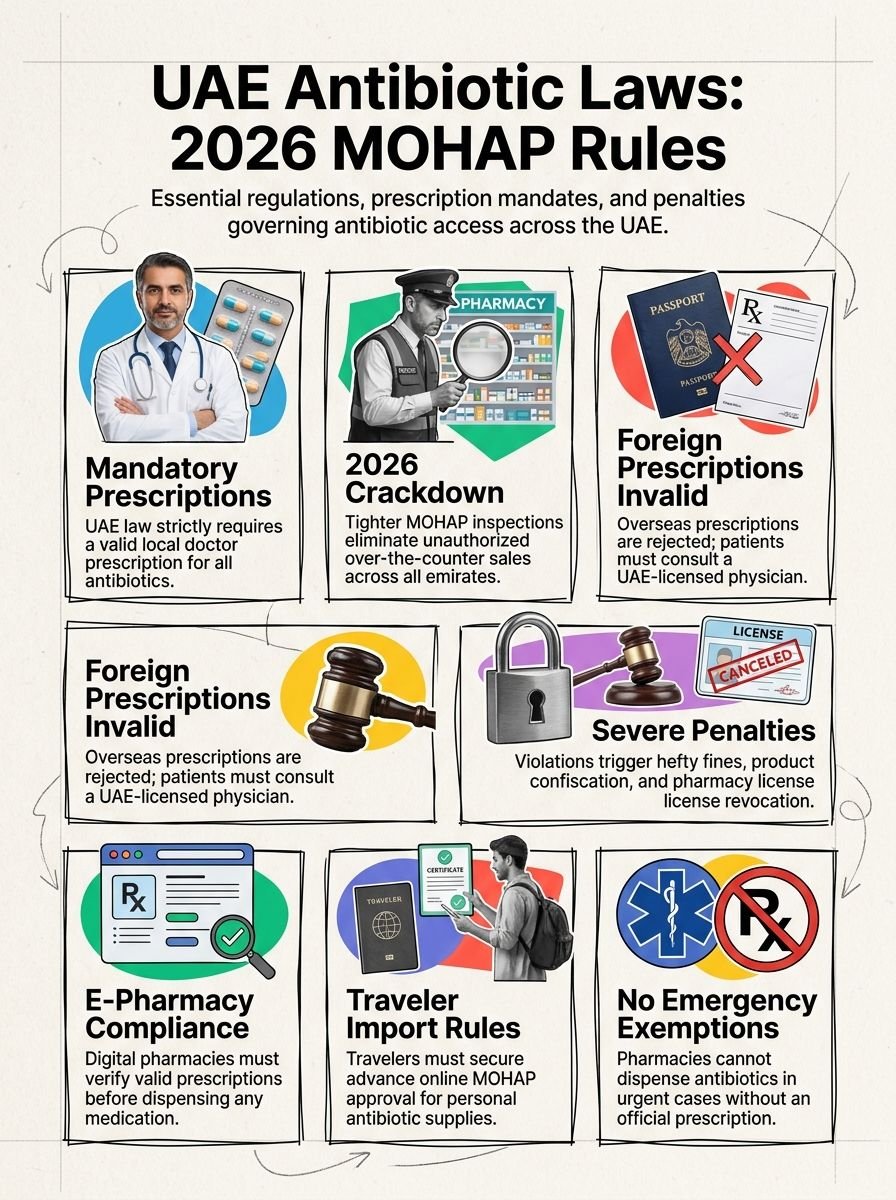
- You cannot buy antibiotics without a prescription in the UAE since 2018, and MOHAP will enforce stricter rules by 2026.
- Pharmacies face serious fines, license suspension, or closure if they sell antibiotics without valid prescriptions from licensed doctors.
- Foreign prescriptions hold no value in the UAE, so expats must get new assessments from licensed UAE doctors for valid prescriptions.
- E-pharmacies must verify every prescription before dispensing antibiotics, following the same strict compliance standards as physical pharmacy locations.
- Antibiotic resistance now contributes to nearly 5 million deaths a year worldwide, with 1.27 million caused directly by resistant infections, according to the World Health Organization’s 2025 Global Antibiotic Resistance Surveillance Report, making the UAE’s 2026 rules essential for public health and safety.
MOHAP Regulations on Antibiotics in the UAE
MOHAP, the UAE’s Health Ministry, set the ground rules for antibiotics back in 2018. Every patient needs a prescription before buying them, no exceptions.
By 2026, those rules get even tighter. Here’s what actually changes.
Watch how MOHAP enforces prescription-only antibiotics
Prescription-only antibiotics since 2018
MOHAP flipped antibiotics to prescription-only status back in 2018. 1 Licensed pharmacies can’t hand over drugs like azithromycin without a valid UAE prescription from a licensed doctor.
I’ve watched this enforcement tighten year after year, touching expats, residents, and business travelers alike. The rule covers every antibiotic, with no over-the-counter workaround.
Pharmacies that break this rule don’t just get a warning. They risk:
- Fines from DHA, DOH, or MOHAP
- Disciplinary action against the pharmacist’s license
- Suspension or full closure of the pharmacy
Foreign prescriptions carry zero weight in the UAE, so travelers and expats need a fresh assessment from a UAE-licensed doctor before any pharmacy will dispense antibiotics. The public health goal here stays simple: control antibiotic resistance and make sure a doctor checks you out before you get medication. 2
Enforcement hasn’t slowed down since 2018, and MOHAP keeps adding inspections and penalties for pharmacies that cut corners. Need antibiotics? Book a doctor’s appointment, get assessed, then bring that prescription to a licensed pharmacy.
These rules matter for anyone living or doing business in the Emirates, especially with stricter enforcement heading into 2026.
Enforcement of stricter rules by 2026
MOHAP is tightening antibiotic sales rules hard heading into 2026. Community pharmacists used to bend the rules and hand over antibiotics without a prescription, 3 but that loophole is closing fast.
A new draft law aims to shut down these unauthorized purchases for good, directly targeting the growing problem of antibiotic misuse and resistance. Businesses and investors should start preparing now.
Here’s a hypothetical example that shows what tighter enforcement can look like in practice:
| Year | Pharmacies Checked | Dispensed Without a Prescription | Noncompliance Rate |
|---|---|---|---|
| 2019 (before enforcement) | 30 | 18 | 60% |
| 2025 (after enforcement) | 30 | 2 | 6.7% |
This scenario is illustrative, not an official audit. But it shows how enforcement guidance and prescription checks can flip pharmacy behavior fast.
Every pharmacy needs proper licensing from DHA, DOH, or MOHAP to legally operate, and e-pharmacies carry that same weight. Pharmacists must verify every prescription before dispensing antibiotics, no matter the channel.
Travelers can’t bring antibiotics into the country without following the approved process either, though emergency situations do have specific rules I’ll cover shortly.
Understanding the Draft Law for 2026
The new draft legislation spells out exactly what pharmacies must do, and what happens if you skip a prescription. It also sets fresh standards for how pharmacies operate day to day.
Watch what the 2026 draft law changes for antibiotic buyers
Key objectives of the new regulations
The 2026 rules chase a few clear goals, and antibiotic resistance sits at the top of the list. This threat is accelerating: the World Health Organization’s 2025 Global Antibiotic Resistance Surveillance Report links resistant infections to nearly 5 million deaths a year worldwide, with 1.27 million deaths caused directly by resistant strains. 5
Resistance is also climbing fast on its own. The same WHO report found resistance rising as much as 15 percent a year, with 1 in 6 confirmed bacterial infections worldwide already resistant in 2023.
Beyond resistance, the UAE government wants to grow local pharmaceutical manufacturing, boost research, and build a regional hub for pharma and biotech by 2026. 4
- Stopping antibiotic misuse and resistance
- Growing local pharmaceutical manufacturing and research
- Enforcing Good Clinical Practice standards in trials
- Tracking drug safety after medicines reach patients
Clinical trials must follow Good Clinical Practice standards, which protect patients and keep trial data trustworthy. Pharmacovigilance systems track drug safety after medicines reach patients, so authorities catch problems early and act fast.
All of this now flows through one body: the Emirates Drug Establishment, or EDE. Marketing authorizations, pricing decisions, and safety monitoring all sit under this single roof.
That consolidation is bigger than it sounds. By early 2026, the EDE had absorbed roughly 44 core regulatory services that MOHAP used to run separately, according to 2026 industry coverage of the UAE’s healthcare regulation overhaul.
Antibiotic resistance poses one of the biggest threats to global health, and the UAE’s 2026 regulations represent a bold step toward protecting both patients and the future of medicine.
For expats and business owners, this means fewer agencies to chase and one clear authority to answer to. These rules protect everyone by creating a legal, verifiable path to antibiotics, and every pharmacy, physical or online, has to verify a prescription before selling anything.
This shift toward strict regulation reflects the UAE’s push to fight antibiotic resistance while building a world-class pharmaceutical system.
Penalties for purchasing antibiotics without a prescription
Buying antibiotics without a prescription carries real legal risk in the UAE, and that risk grows as enforcement tightens through 2026. The law imposes substantial fines on anyone who gets these medications illegally, and the consequences reach beyond your wallet.
Under the UAE’s narcotics law amendments, in force since late 2025, unauthorized dispensing of controlled substances can trigger a fine starting at AED 50,000 and up to five years in prison, according to 2025-2026 legal-industry reporting on the reforms.
- Fines starting at AED 50,000
- Up to five years in prison for unauthorized dispensing
- Seizure of the purchased medication
- License suspension or revocation for the pharmacy involved
Your reputation takes a hit too, and businesses caught selling without authorization risk losing their pharmacy license entirely. 2
The 2026 draft law raises these penalties even further to fight ongoing misuse. Buying without proper documentation now draws heightened scrutiny from regulators, and pharmacies caught breaking the rules lose their ability to operate.
These enforcement measures protect public health by slowing the spread of antibiotic resistance, a growing threat across the region.
The Role of Pharmacies in Compliance
Pharmacies across the UAE answer to MOHAP, DHA, or DOH to keep their license active. These facilities sit at the center of antibiotic control, verifying every prescription before a sale goes through.
See how licensed pharmacies handle prescription verification
Licensing requirements for pharmacies (DHA/DOH/MOHAP)
Running a pharmacy in the UAE means holding a valid operating license from DHA in Dubai, DOH in Abu Dhabi, or MOHAP at the federal level. Getting there takes a stack of paperwork.
- Scientific and academic certificates
- Recent experience certificates from past employers 6
- A valid assessment certificate
- Passport, family book, and ID card 7
- Recent color photographs
These standards confirm proper pharmaceutical ownership and keep documentation consistent across the board. Regulators review every credential closely before issuing a license, and renewal follows that same scrutiny.
I take this process seriously, because the penalties for cutting corners run steep. A pharmacy that skips prescription checks or other compliance steps can see its license suspended or pulled entirely.
Staying licensed takes constant attention to detail. Documentation needs to stay current, and ownership structure has to match what regulators expect.
E-pharmacies and their responsibilities
E-pharmacies in the UAE carry the same weight as physical stores under MOHAP and DHA rules, especially when antibiotics are involved. 9 Every prescription needs verification before an order ships, and drug authenticity gets checked at each step.
Here’s a detail investors often miss: an e-pharmacy can’t launch as an online-only business. DHA, and equivalent MOHAP and DOH rules, require the operator to hold a standard physical pharmacy license first, then apply separately for an online-dispensing permit, according to current DHA licensing guidance summarized in 2025-2026 consultancy reports.
Telepharmacy services must match the standards of a physical pharmacy. Patient records get checked, and a licensed pharmacist confirms every antibiotic order before it ships.
- Verify every prescription before dispensing
- Keep a licensed pharmacist checking each antibiotic order
- Document the entire verification process
- Report suspicious antibiotic requests to authorities
Stakeholder engagement matters for e-pharmacies to succeed across the emirates. 8 Regulatory compliance creates real hurdles during setup, but good planning clears most of them.
The e-pharmacies that thrive past 2026 will be the ones investing in solid systems, trained staff, and a real commitment to patient safety over convenience.
Exceptions and Special Cases
Emergency situations sometimes call for fast access to medication, prescription or not. UAE healthcare rules, under MOHAP, do allow a few special cases for urgent needs or travel.
Emergency use of antibiotics without prior prescription
Emergency dispensing without a valid prescription is not allowed under UAE law, full stop. 1 That rule applies to everyone: residents, expats, and business travelers alike.
Health authorities have enforced this strictly since 2018, and the 2026 regulations tighten it further. Pharmacies face steep fines for handing over antibiotics without proper documentation, even when a patient insists it’s urgent.
Community pharmacists used to allow some wiggle room here, 3 but that’s disappearing fast across the emirates. The new rules close that gap entirely, with no exceptions for emergency situations.
- No verbal-only requests, even for urgent symptoms
- No foreign prescriptions accepted as substitutes
- Fines apply to the pharmacy, not just the buyer
Plenty of expats assume a health emergency creates a loophole. It doesn’t, at least not under current UAE law.
Pharmacists now verify every prescription strictly before dispensing antibiotics, and violations bring real penalties for both the pharmacy and its staff.
My advice: get a prescription from a licensed provider before you head to any pharmacy, urgent or not.
Approved process for obtaining antibiotics during travel
Travelers heading to the UAE need to follow a specific approval process to bring antibiotics with them. Visitors can carry up to three months’ supply of approved medication, antibiotics included, as long as the paperwork is ready.
Residents get a longer leash: up to twelve months’ supply for personal use. Foreign prescriptions for controlled medications, antibiotics among them, don’t work at UAE pharmacies, so plan ahead. 10
The official channel is MOHAP’s “Issue of Permit to Import Medicines for Personal Use” service, accessed through UAE PASS on the MOHAP website or smart app. It requires a prescription issued within the last three months and stamped by the treating healthcare facility, and it confirms that three-month cap for visitors.
Here’s a hypothetical timeline that shows what the approval process can look like in practice:
| Day | Step |
|---|---|
| Day 0 | Applicant uploads prescription and medical summary |
| Day 2 | Automated acknowledgment received |
| Day 5 | Authority requests additional documents |
| Day 7 | Applicant responds with requested documents |
| Day 9 | Authorization letter issued |
This example is illustrative, not a guaranteed timeline. Real approvals still land around five to ten business days, so submit well ahead of your travel dates.
Telemedicine makes getting a prescription easier these days. Registered UAE doctors can issue one remotely, which speeds up the whole process for expats.
- Original prescription and medical reports
- Valid ID or passport copy
- Residency status and travel dates
- Medication names and dosages
Having everything organized in advance saves time and avoids delays at customs. UAE pharmacies only dispense antibiotics once you show an approved MOHAP authorization letter alongside a valid prescription from a registered doctor.
Emergency contraception in the UAE: rules, where to buy, privacy, and age requirements
This protects public health by keeping antibiotic approval in the hands of qualified professionals, and that same compliance mindset carries over to other urgent medication needs. Plenty of people come here seeking urgent legal assistance around emergency contraception too.
EllaOne 30MG contains 30 mg of ulipristal acetate and costs AED 84.50 with VAT included. It works up to 120 hours after unprotected sex, giving you a real window to act.
You can order it through pharmacies with free delivery on orders over AED 29, or pick it up through Click & Collect. Customer support runs 24/7 for these purchases, and the product holds a 4.7 out of 5 rating from 141 reviews. 11
- Free delivery on orders over AED 29
- Click and Collect for in-person pickup
- Four interest-free installments on orders above AED 300
- 24/7 customer support for urgent purchases
Birth control has needed a prescription at UAE pharmacies since 2018, yet emergency contraception stays accessible through specific channels that protect your privacy. Confidentiality holds throughout the entire transaction.
Conclusion
Getting antibiotics in the UAE comes down to one thing: a valid prescription from a licensed physician. MOHAP makes this crystal clear heading into 2026.
Pharmacies, e-pharmacies, and delivery services all have to verify that prescription before they dispense anything. Skip this step, and you’re looking at serious fines, license suspension, or worse.
Understanding these controlled drug policies protects your health while backing the UAE’s fight against antibiotic resistance.
Talk to a licensed doctor through a clinic, hospital, or approved telehealth app to get the medication you need, safely and legally.
FAQs
1. Do you need a prescription to buy antibiotics in the UAE?
Yes, MOHAP requires a valid prescription for antibiotics at licensed UAE pharmacies. This is part of the UAE’s antimicrobial stewardship program to combat drug resistance.
2. What is MOHAP, and why does it control antibiotic sales?
MOHAP is the Ministry of Health and Prevention, which sets all health regulations in the UAE. It controls antibiotic sales because antimicrobial resistance causes about 1.27 million deaths globally each year according to WHO. The UAE’s strict rules help preserve antibiotic effectiveness for future generations.
3. Can pharmacies in the UAE face penalties for selling antibiotics without a prescription?
Yes, pharmacies that violate MOHAP regulations face substantial fines, official warnings, and potential license suspension or revocation.
4. Are there any exceptions to the prescription rule for antibiotics in 2026?
Some topical antibiotic creams like mupirocin may not require a prescription, but I recommend checking with a licensed UAE pharmacist first since most oral and injectable antibiotics do.
References
- ^ https://doctorsfinder.com/do-you-really-need-prescription-for-antibiotics/
- ^ https://www.researchgate.net/publication/396453692_The_Legal_Implications_of_Selling_Antibiotics_without_Prescriptions_in_the_UAE
- ^ https://pmc.ncbi.nlm.nih.gov/articles/PMC6850897/
- ^ https://practiceguides.chambers.com/practice-guides/life-sciences-2026/uae/trends-and-developments
- ^ https://pmc.ncbi.nlm.nih.gov/articles/PMC12777936/
- ^ https://mohap.gov.ae/en/w/licensing-of-pharmacists (2026-07-10)
- ^ https://mohap.gov.ae/en/w/licensing-of-a-pharmaceutical-facility (2026-07-10)
- ^ https://pmc.ncbi.nlm.nih.gov/articles/PMC11499724/
- ^ https://link.springer.com/rwe/10.1007/978-3-030-74786-2_479-1
- ^ https://www.pharmacydirectory.ae/emergency-antibiotic-without-prescription-pharmacy-uae-legal/ (2026-01-16)
- ^ https://www.lifepharmacy.com/product/ellaone-30mg-fc-tab-1s