
Every relocation advisor I know has a story about a client’s suitcase getting pulled aside at Dubai International over a bottle of prescription pills.
That’s not bad luck.
It happens because the UAE’s medication rules catch people off guard. The Ministry of Health and Prevention (MOHAP) requires a permit before you bring most prescription medication into the country, and getting that MOHAP permit right is the whole game.
From what I’ve seen helping expats through this process, that permit is really the dividing line. It separates a routine customs check from a confiscated suitcase and a long conversation with airport security.
So here’s the plan. I’ll walk you through the MOHAP permit process step by step, break down exactly how much medication you can carry, flag which drugs are banned outright, and cover what to do the moment you land.
Key Takeaways
- Get your MOHAP permit before you fly. Skipping it risks confiscation, fines, or worse at UAE customs.
- Travelers can carry a three-month supply of controlled substances. Residents get up to a twelve-month supply with the right documentation.
- Cannabis, CBD oil, and poppy seeds are completely banned. The UAE enforces a zero-tolerance policy with fines, jail time, or deportation.
- Tramadol, codeine, Xanax, and Adderall all need MOHAP authorization, a valid prescription, and original pharmacy packaging.
- Declare every medication at customs with your approval certificate, prescription, and a medical report dated within the last three months.
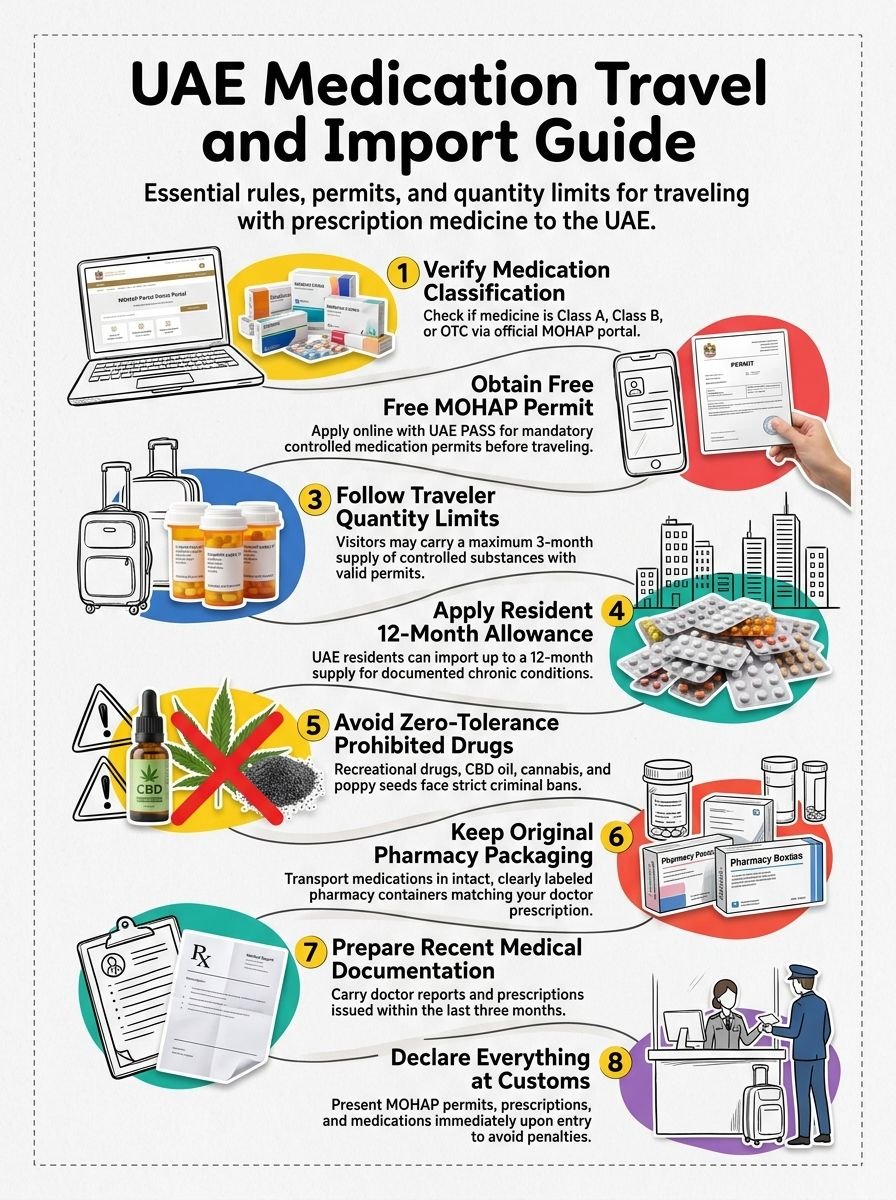
MOHAP Permit Process for Medication
Getting a MOHAP permit before you fly breaks down into three clear stages: verify your medication’s legal status, gather your documents, and then submit everything to the Ministry of Health and Prevention for an approval certificate.
Confirm your medication’s classification
I always confirm my medication’s classification before I book a flight to the UAE. The Ministry of Health sorts every drug into specific categories, and my approval depends on getting this right.
A quick conversation with your doctor settles whether your medication counts as a controlled substance or an over-the-counter option. Non-controlled and over-the-counter medications skip the MOH approval step entirely, which makes life much easier if your prescription falls into this group.
Controlled medications work differently. They need prior approval from the Ministry of Health, so this verification step can’t be skipped.
The Emirates Drug Establishment Portal or the MOHAP Portal will confirm your medication’s status directly, saving you time and guesswork. Unsure about a specific drug? The nearest UAE Embassy or Consulate can walk you through the classification too.
Narcotic and psychotropic drugs split into two tiers: Class A, which faces the tightest controls, and Class B, a semi-controlled tier. Both categories carry import restrictions without proper approval, so this distinction is worth taking seriously.
Knowing your medication’s classification before arrival transforms your entire UAE entry experience into a smooth, stress-free process.
Confirming classification early prevents customs delays and legal headaches at the airport. Once you know your medication requires a permit, the next move is gathering documents for the MOHAP application.
Prepare and submit required documents
Once classification confirms you need a permit, document prep begins. Three items are required.
- A valid medical prescription issued within the last three months
- An official medical report or doctor’s letter listing your name, the medicine name, dose, dosage form, and treatment duration
- A passport identification page
I make copies of everything before submitting, since customs wants the originals and I want backups for my records. My prescription and medical report form the foundation of the whole application, so double-checking every detail pays off.
Submission happens through the UAE Ministry of Health website. Accuracy matters here, since fudging a dosage or a date only slows down your own approval.
One applicant I know of uploaded a prescription, a medical report dated within 45 days, and a passport page. The portal accepted the submission on the first try, sent an automated confirmation within two hours, and flagged the file as “under review” by the second day. That kind of turnaround is normal when your documents are complete and well organized.
Health officials review your classification and dosage details next. Approval arrives by email, and I always print several copies to carry alongside my original prescription and medical report. That approval certificate becomes your legal green light to bring medication into the UAE.
Receive and carry the approval certificate
The approval certificate arrives after MOHAP reviews your documents, submitted through the Emirates Drug Establishment or MOHAP Portal using UAE PASS. This certificate is your official permission to bring controlled medication into the UAE, so carry it at all times while traveling.
The Ministry of Health issues this permit for free, so there’s no added cost to applying. According to MOHAP’s own “Issue of Permit to Import Medicines for Personal Use” service page, the personal-use import permit typically takes three to five business days to process, and the electronic permit stays valid for 60 days from the date it’s issued. That validity window matters: apply too early, and your permit could expire before you travel.
Time your application close to your travel or shipping date, but not so close that a processing delay leaves you without approval at the airport. A week or two before departure is a safe window for most travelers.
Your approval certificate works alongside your valid prescription, and both become essential the moment you reach customs. Keep the certificate somewhere safe, next to your original medication packaging and medical report, because customs officers will ask for all three.
Presenting your certificate proves you secured authorization before you ever left home. Whether you’re treating a short-term issue or managing a chronic condition, this documentation protects you from legal trouble at the border and sets up a smooth declaration when you land.
Quantity Limits for Bringing Medication
Quantity limits apply to every prescription and controlled substance you bring into the UAE, and knowing the exact numbers matters more than most travelers realize. MOHAP sets strict pharmaceutical guidelines here, and following them protects both your health and your legal standing.
Limits on controlled substances
In my years advising UAE expats, controlled substance limits come up constantly. Travelers and residents face different rules, and the difference catches a lot of people off guard.
| Category | Supply Limit | Key Details | Examples |
|---|---|---|---|
| Travelers | Three-month supply maximum | Must follow prescription dosages. Original pharmacy packaging required. MOHAP approval certificate needed. | Opioids, codeine, tramadol, benzodiazepines, ADHD medications |
| Residents | Twelve-month supply allowed | Extended duration for established residents. Original labels must remain intact. Identifiable pharmacy packaging required. | Tramadol, xanax, adderall, codeine, controlled narcotics |
| Class A Drugs | Three-month limit for travelers | Narcotic and psychotropic substances. Stricter regulations apply. MOHAP permit is mandatory. | High-potency opioids, morphine, certain psychotropic medications |
| Class B Drugs | Three-month limit for travelers | Semi-controlled substances. Still require MOHAP certification. Original pharmacy labeling essential. | Some benzodiazepines, codeine-based products |
Quantity restrictions exist for real safety reasons, not bureaucratic red tape. Travelers can’t exceed a three-month supply, calculated against their prescribed dosage. Residents get more room, up to a twelve-month supply, which brings real relief for anyone managing a chronic condition long-term.
Class A narcotic and psychotropic substances draw the strictest enforcement. Class B semi-controlled drugs still demand the same attention to documentation and packaging.
Here’s what trips people up most:
- Exceeding the supply limit, even by accident, invites confiscation and legal trouble
- Original pharmacy packaging with clear, identifiable labels smooths every inspection
- Opioids, codeine, tramadol, ADHD medications, and benzodiazepines all fall under these caps
- Long-term residents benefit most from the extended twelve-month allowance
Controlled medication imports stay fully legal as long as you follow the UAE’s regulatory framework. Travelers on shorter visits should pack within the three-month threshold and plan accordingly.
A review of traveler experiences shows packaging and labeling compliance as a common problem area. Most travelers arrive with original pharmacy labels intact, yet a notable minority show up without a patient name on the label, or with a supply that exceeds the three-month threshold once daily doses are calculated.
Verifying your label and confirming your exact quantity before travel closes this gap. Make sure your pharmacy label shows your name clearly, and match your supply to the three-month traveler limit or the twelve-month resident limit.
Guidelines for common medications
Understanding what counts as a common medication makes customs a lot less stressful. Many standard drugs need no MOH approval at all, which simplifies entry significantly.
| Medication Type | Permit Required | Maximum Supply Allowed | Documentation Needed |
|---|---|---|---|
| Paracetamol | No | Six-month supply | Original packaging only |
| Ibuprofen | No | Six-month supply | Original packaging only |
| Standard Antibiotics | No | Six-month supply | Medical prescription |
| Over-the-Counter Medications | No | Six-month supply | Original packaging only |
| Non-Controlled Prescription Medications | No | Six-month supply | Medical prescription and original packaging |
| Vitamins and Supplements | No | Six-month supply | Original packaging only |
Paracetamol, ibuprofen, and standard antibiotics travel freely without special authorization. Over-the-counter medications fall into the same category, needing only original packaging for customs clearance.
Non-controlled prescription medications deserve a closer look. Visitors can bring up to a six-month supply of these drugs without MOHAP approval, as long as a doctor’s letter, issued within the last three months, specifies dosage and duration.
A few practical rules keep this simple:
- Keep every medication in its manufacturer’s original container with intact labels
- Carry a medical prescription as proof of legitimacy for any prescription drug
- Expect UAE pharmacies to stock common pain relievers, cold medicine, and digestive aids if your supply runs short
- Treat vitamins and supplements the same as over-the-counter medications, up to a six-month supply
Customs officials scrutinize unlabeled or repackaged items, and that scrutiny can delay your entry. A doctor’s letter detailing the diagnosis and treatment plan strengthens your declaration and helps your medication clear customs without extra questions.
These guidelines cover the medications most travelers carry. Controlled substances require far more stringent attention and specific MOHAP permits, which the next section covers in detail.
Banned and Controlled Medications
Some medications face an outright ban in the UAE, while others just need a special permit from health authorities. Knowing the difference between prohibited substances and controlled drugs lets you travel with confidence and stay compliant with UAE pharmaceutical guidelines.
Prohibited substances (cannabis, CBD oil)
Some items are worth ruling out before you ever pack a bag. Cannabis and CBD oil are completely prohibited in the UAE, even though both are legal in plenty of other countries.
The UAE enforces a zero-tolerance policy on recreational drugs. Carrying banned substances into the country brings real consequences: fines, imprisonment, or deportation if customs enforcement catches you.
The Ministry of Health keeps an updated list of banned substances, and these narcotics top that list with no exceptions. This zero-tolerance framework isn’t just customs policy. It’s written into Federal Decree-Law No. 30 of 2021 on Combating Narcotics and Psychotropic Substances, which criminalizes the import, possession, and transport of these substances outside regulated medical use.
- Cannabis and any cannabis-derived product, including CBD oil
- Poppy seeds, often overlooked but flagged at customs
- Any recreational narcotic outside MOHAP-approved medical use
Some medications legal elsewhere still get banned here, so verify each drug before packing. Your best move is checking with the health ministry before you travel and confirming every medication you carry complies with UAE law. Attempting to bring anything on the prohibited list risks consequences that follow you well beyond your trip.
Controlled drugs requiring permits (opioids, ADHD medications)
Controlled drugs requiring permits include opioids, codeine, tramadol, ADHD medications, and benzodiazepines like diazepam and alprazolam. These substances fall into two categories, Class A (CDa) and Class B (CDb), based on their addiction and abuse potential.
Many people underestimate how strict this classification system really is. Each controlled drug demands prior authorization from MOHAP before it enters the country.
The stakes are real. Under Federal Decree-Law No. 30 of 2021, a first-time offense for unauthorized possession of a controlled substance carries a minimum of three months in prison and a fine between AED 20,000 and AED 100,000. Repeat offenses escalate fast, with a third offense carrying a mandatory minimum of two years’ imprisonment.
A valid prescription is non-negotiable for every controlled medication. Residents have faced real complications at customs simply because they lacked proper documentation for a prescribed opioid or ADHD medication.
Getting the correct permit comes down to a short checklist:
- Confirm your medication’s classification with MOHAP first
- Get a locally issued prescription; a foreign prescription alone won’t clear approval
- Keep medication in original packaging with pharmacy labels intact
- Start your application well before your travel date, since authorization takes time
Families traveling with children on controlled medications face extra requirements. Documentation must link directly to the child’s passport for full compliance. One family learned this the hard way when they first tried traveling with only a foreign prescription for their child’s ADHD medication, and airline check-in denied boarding. After they secured MOHAP approval, a locally issued supporting prescription, and matched the declared quantity to the three-month allowance, customs cleared them without issue on the second attempt.
Residents and long-stay patients needing ongoing controlled medication need proper licensing and permits from MOHAP. Staying consistently compliant is what keeps customs clearance smooth every time, and the classification system protects public health while still allowing legitimate medical access for anyone with proper authorization.
Specific rules for tramadol, codeine, Xanax, and Adderall
For a deeper breakdown of these four medications, see this guide to controlled medicine rules in the UAE. Tramadol, codeine, Xanax (alprazolam), and Adderall are the most common controlled drugs that travelers and residents bring into the country.
Codeine counts as a controlled drug in the UAE, so you need permission for any medication containing it, including co-codamol. Tramadol and Xanax also require permits, since the Ministry of Health keeps an updated list of controlled substances that governs all three.
Travelers can bring a maximum three-month supply of controlled medications. Residents get a twelve-month supply with proper documentation. Foreign prescriptions don’t work for controlled medications, so a local prescription has to support your application.
All medications must stay in their original packaging with a valid prescription throughout your trip. Submit your application before you arrive in the UAE through MOHAP, and carry your approval certificate at all times when traveling with these substances.
Steps to Follow at UAE Customs
UAE customs follows a specific process when you bring medication into the country, and knowing the steps in advance makes the whole thing painless.
Declare medications upon arrival
Declaring medication at the port of entry isn’t optional. It’s a legal requirement that protects you from serious consequences. Customs authorities expect travelers to declare every controlled substance, prescription drug, and over-the-counter medication during the declaration process.
Failing to declare controlled medicines can lead to confiscation, hefty fines, or even imprisonment. The three-month supply limit applies to controlled substances, so excessive quantities without proper documentation raise red flags fast.
Have these four items ready before you reach the counter:
- Your MOHAP approval certificate
- Your original prescription
- A medical report dated within the last three months
- Medications in original, labeled packaging
Controlled medications for children need documentation linked to the child’s passport. Transit passengers should check the specific rules and permits for their medication before boarding, since different requirements apply depending on travel status.
Understanding what happens during a customs inspection sets realistic expectations. One traveler carrying a controlled benzodiazepine went through arrival and declaration in ten minutes, followed by a twelve-minute document check. The officer then called for a secondary inspection, adding roughly an hour. After presenting the MOHAP approval certificate and medical report, the traveler was released within fifteen minutes, for a total delay under two hours.
That timeline shows something worth remembering: carrying your MOHAP approval and supporting documents can cut your hold time significantly during a secondary inspection. Declaring your medication upfront is simply the smart move for staying on the right side of UAE law.
Ensure original packaging and proper documentation
Keeping medication in its original packaging matters more than most travelers realize. Customs officials inspect packaging carefully, and torn boxes or missing labels can cause real delays at the airport.
Labels need to show four things clearly:
- The patient’s name
- The medicine name
- The dose and dosage form
- The treatment duration
Customs agents cross-check this information against your paperwork, so everything needs to match. Carry a valid medical prescription and an official medical report for any controlled medication, both issued within the last three months.
Keep your approval certificate accessible, not buried in checked luggage, and store your prescription paperwork in a separate, organized folder. The inspection moves faster when your packaging stays intact and your documentation is complete.
Travelers who skip these steps risk confiscation. Presenting everything in order, original packaging plus complete documentation, is what keeps the process quick and stress-free for UAE expats and business travelers alike.
Conclusion
Bringing medication into the UAE comes down to three things: understanding MOHAP permit rules, knowing the banned drug list, and respecting quantity limits.
Start by figuring out which medications need a permit and which ones face outright prohibition. Getting the right documentation, keeping medications in original packaging, and declaring everything at customs protects you from confiscation or legal trouble.
Following these steps keeps your trip compliant with UAE health authorities and stress-free. Take care of this before you fly, because it’s the difference between a routine customs check and a very bad day at the airport.
FAQs
1. Do I need a permit to bring medication to the UAE in 2026?
Yes, I need a MOHAP permit for most prescription medications. I apply online through the Ministry of Health and Prevention portal at least two weeks before my travel date.
2. What drugs are banned in the UAE?
The UAE bans tramadol, codeine-based medications, and benzodiazepines like diazepam. I always verify my medications against the official MOHAP controlled substances list before packing.
3. How much medication can I bring into the UAE?
I can bring up to a three-month supply for personal use with a valid prescription. Larger quantities require additional MOHAP approval.
4. What happens if I bring medication without approval?
Customs can confiscate my medication immediately. I could face fines starting at AED 5,000 or prosecution. Getting the permit beforehand prevents serious legal trouble.
References
- ^ https://www.uae-embassy.org/permitted-prescriptionsdrugs-while-entering-uae
- ^ https://www.facebook.com/beoehq/posts/uae-drugs-laws-carrying-of-medicines-to-uae/1501950261976373/
- ^ https://mohap.gov.ae/documents/20117/1212145/06_Issue+of+Permit+to+Import+Medicines+for+Personal+Use.pdf/ce8edee4-aa21-ec81-e90c-78e9b22ae58b?t=1739123385747
- ^ https://www.aetnainternational.com/en/health-wellness/destination-guides/expat-guide-to-dubai/medication-dubai.html (2025-12-17)
- ^ https://www.uaeexperthub.com/bringing-medication-to-uae-guide/